The Pediatric Intensive Care Unit at Nicklaus Children’s Hospital is a 40-bed unit that provides sophisticated technologies and procedures for high acuity, critically ill infants, children and adolescents from birth to 21 years of age. Aside from the hospital’s overarching mission – to inspire hope and promote lifelong health by providing the best care to every child – and its vision – to be where the children are – the Pediatric Intensive Care Unit uniquely devised, through a multi-disciplinary approach, its own mission, vision, and values to guide care.
Treatments and Procedures
Treatments and Procedures
Our children's intensive care is also one of three pediatric apheresis blood treatment centers in the state and the only one operating 24 hours a day. We offer:
Conditions We Treat
The Pediatric Intensive Care Unit at Nicklaus Children’s Hospital prides itself in a multi-disciplinary structural framework. Due to the various sub-specialties located within the hospital, we are able to effectively treat a wide variety of critical conditions. Some of these sub-specialties include Cardiology, Endocrinology, Gastroenterology, Hematology and Oncology, Infectious Disease, Neurology, Neurosurgery, Nephrology, Pediatric Surgery, and Pulmonology. Below are a few of the most treated conditions within our Pediatric Intensive Care Unit.
- Congenital/Acquired Heart Defects
- Cardiac Arrest
- Chest Pain and Angina
- Hypertensive Crisis
- Shock
- Diabetic Ketoacidosis
- Hyperglycemic Hyperosmolar Syndrome
- Bowel Obstructions/Perforations
- Chron's Disease
- Hepatic Failure
- Peritonitis
- Disseminated Intravascular Coagulation
- Post Bone Marrow Transplant Complications
- Tumor Lysis Syndrome
- Neurodegenerative Disorders
- Status Epilepticus
- End-Stage Renal Disease
- Acute Respiratory Failure
- Pulmonary Embolism
- Persistent Pulmonary Hypertension of the Newborn
- Status Asthmaticus
- Ingestions/Poisonings
- Traumas
- Steven Johnson Syndrome
Children's Intensive Care LifeFlight® Transport
Many neonatal and pediatric patients at other hospitals who face life-threatening medical conditions requiring critical care are transferred to Nicklaus Children's Pediatric Intensive Care Unit by a specialized mobile intensive care unit known as LifeFlight®.
This highly trained team of physicians, nurses, EMTs and paramedics utilizes self-contained life-support equipment to stabilize, treat and monitor a child upon contact at the referring facility and throughout transport via ground, helicopter or fixed-wing ambulance.
Learn More
Family-Centered Care
Whether a patient is admitted to Nicklaus Children's PICU under the care of a personal physician, by a staff physician, or through another intensive care unit, the child becomes the center of a multi-disciplinary team effort. More than 100 critical care nurses monitor patient progress minute-to-minute, 24 hours a day, seven days a week. Nurses are situated in alcoves between rooms in order to make them readily accessible to patient and family needs.
Family-centered care is the main core of the unit’s processes. Happy Family Rounds occur every morning with a visit from a patient-family representative, case manager, and PICU unit manager to address any needs and concerns. In addition, family members are encouraged to participate in daily physician rounds. Multi-disciplinary meetings are also coordinated on a needs basis with families.
The water-themed PICU attempts to provide a tranquil and comfortable environment for patients and families. All rooms are private with a family area that includes a couch that pulls out into a full-sized bed, a large screen TV, internet access, and private bathroom. For added comfort, there is a family lounge on the unit with a coffee maker, refrigerator, microwave, dining tables, sofa, and TV.
We understand that respirators, EKG monitors, intravenous tubes, and the technology of today's children's intensive care can overwhelm a child and family. Aside from the Get Well Network that provides access to the internet, movies, and patient-specific education at the bedside through the TV, the medical staff of Nicklaus Children's PICU is supported by an extensive and family-centered, human resources team that includes social workers, child life specialists, hospital chaplains, and volunteers.
Learn More
Our Mission, Vision and Values
Mission: The Pediatric Intensive Care Unit at Nicklaus Children’s Hospital is a unique academic and family-centered environment dedicated to providing barrier-free access to achieve the best outcomes.
Vision: The Pediatric Intensive Care Unit at Nicklaus Children’s Hospital is the leading center of comprehensive care for every critically ill child.
Values: At the Pediatric Intensive Care Unit at Nicklaus Children’s Hospital our core values are to provide family-centered care through:
- Pursuing Excellence
- Practicing Integrity and Respect
- Promoting Collaboration in Care
- Innovation
- Ownership and Initiative
Successful Outcomes
Nicklaus Children's PICU patients spend more than 2,000 patient days attached to ventilators each year another measure of the units acuity of care. Despite handling the most severely stricken children (with an average of nearly 300 patients transferred from other hospitals every year), Nicklaus Children's intensive care consistently outperforms the national averages, both in mortality rates (2% vs. 6%) and in length of patient stays (3.5 days vs. 4.7 days).
Successful outcomes such as these speak directly to the value of specialized child care. Nicklaus Children's Pediatric ICU has reached a critical mass in acute care for children and it shows. The experience of staff physicians and clinical care nurses, their procedures and even their equipment reflect the particular needs of children.
According to VPS, an independent national ICU database, the Pediatric Intensive Care Unit at Nicklaus Children's Hospital maintains one of the best outcomes in the country, with an average mortality of 1.77% from 2005 to 2011, as compared to 2.84 % among our peers. Our standardized mortality ratio (ratio of actual mortality to expected mortality) is 0.57 compared to 0.96 in our peer group.
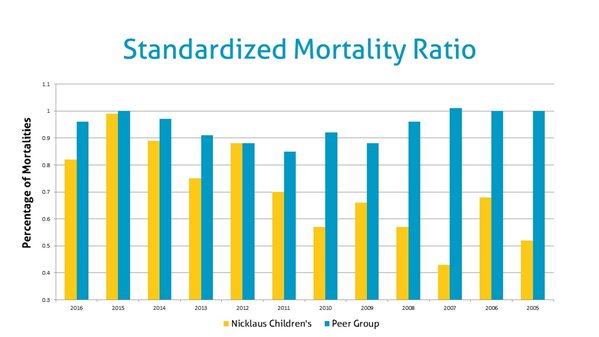
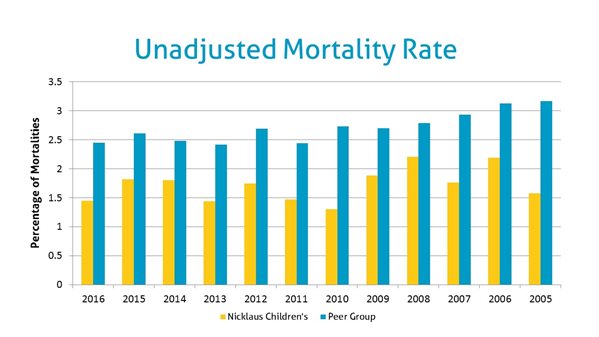
Source: VPS Participant Sites